
Ask a homeowner what keeps rain out of their house and they will point at the tile. It is the part they can see, it is the part that cost the money, and it looks like armour. Concrete and clay tile is genuinely tough - a tile roof in Palm Beach County can carry fifty years of sun without much complaint.
But the tile is not the waterproofing. The tile is the wear layer. It takes the sun, the rain and the impact so that the thing underneath does not have to. The waterproofing is the underlayment - the membrane lying on the plywood, out of sight - and it has a materially shorter life than the tile sitting on top of it.
That single fact explains most of what confuses people about tile roofs: why a roof with perfectly good-looking tile can leak, why a re-roof often reuses the original tile, and why an annual look underneath the surface is worth anything at all.
What is actually up there
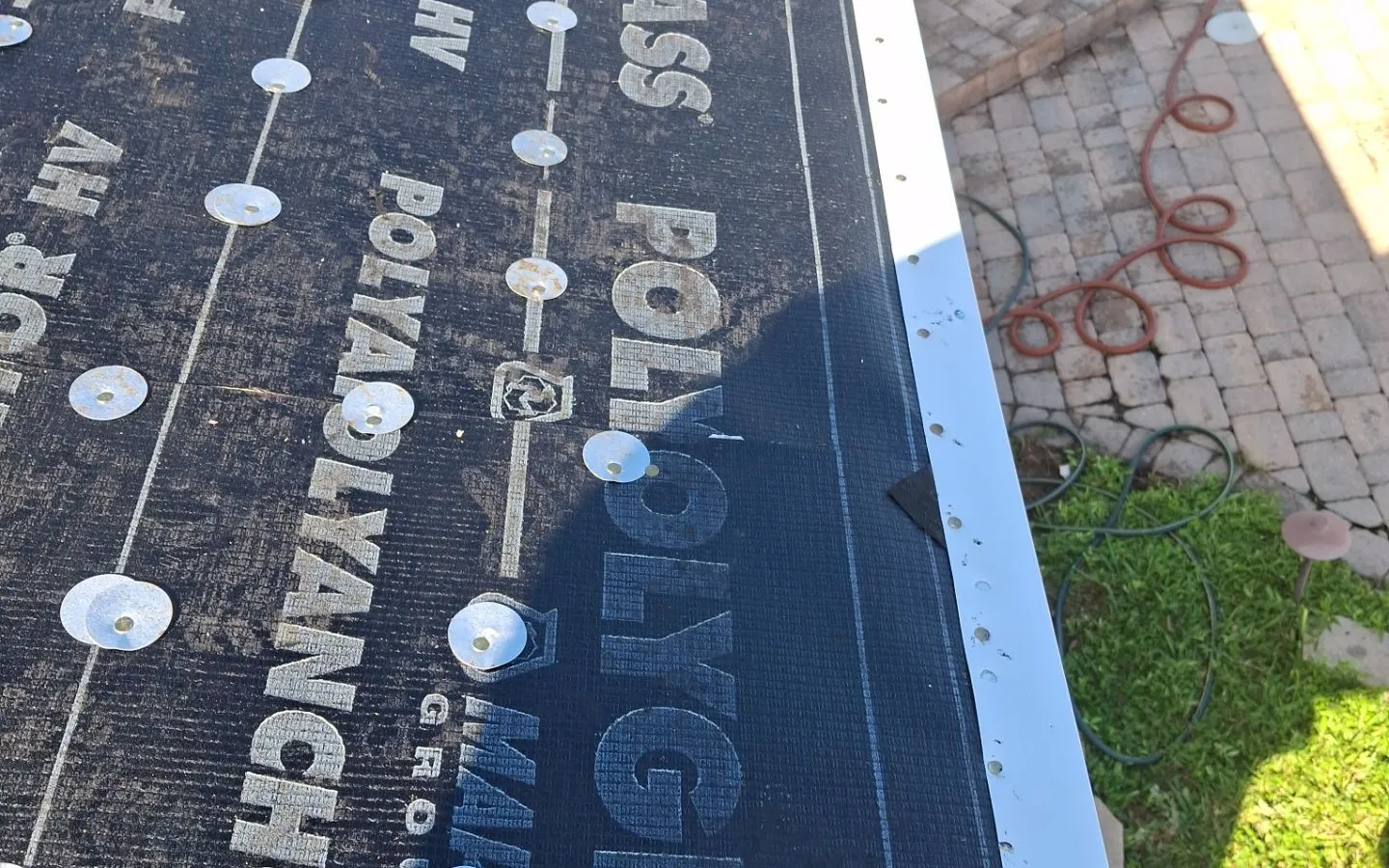
On a current Palm Beach County tile re-roof, the stack from the plywood up is usually:
- The deck - plywood, re-nailed to current code at tear-off.
- An anchor sheet - mechanically fastened with nails and caps.
- A self-adhered cap sheet - this is the actual waterproofing.
- The tile - set in foam adhesive, not nailed through the membrane.
Worth being precise about the anchor sheet, because it gets misdescribed constantly: the manufacturer states plainly that the anchor sheet is not a primary waterproofing membrane, and that an approved self-adhered underlayment must always go over it. It is there to hold the assembly down and keep the deck dry temporarily. It is not the thing standing between your ceiling and a thunderstorm.
Why your tile is probably fine and your underlayment probably is not
Concrete tile weathers slowly. Underlayment lives in a hot, dark, poorly ventilated space, bakes for two decades, and gets brittle. When a tile roof starts leaking in its twenties, the tile is very rarely the reason. The membrane has aged out.
Which is why a tile re-roof often looks strange from the street: the crew lifts and stacks the existing tile, strips everything underneath, rebuilds the waterproofing, and puts a good proportion of the original tile back down. The roof looks the same afterwards. The part that matters is entirely new.
What this means for maintenance
If the waterproofing is hidden, you cannot judge a tile roof by looking at it. What you can do is watch the places where water is concentrated and where the membrane is most exposed:
- Valleys and crickets - where two planes meet, water volume multiplies, and debris collects and holds moisture against the membrane.
- Hip and ridge - the mortar and the closure detail along the top lines.
- Wall transitions and flashings - where the roof meets something vertical.
- Penetrations - every pipe, vent and stack is a hole that was sealed once.
- Broken and slipped tile - not a leak in itself, but a missing tile means the membrane is taking direct UV, which ages it fast.
None of that is visible from the driveway. All of it is visible from the roof.
The honest version
Nobody can tell you how many years are left in an underlayment without getting up there, and anyone who quotes you a number from the ground is guessing. What a scheduled visit gives you is narrower and more useful: the condition of the details where failure actually starts, photographed and dated, so that next year's photographs can be compared against this year's.
A roof does not fail all at once. It fails at one detail, quietly, for a while first.
Roof Sentry members get that comparison every year - dated photos, a written condition report and a roof map.
Compare the plans