Metal roofing gets sold on longevity, and the panels deserve the reputation. A properly installed metal roof in Palm Beach County can run for decades. But "the panels last fifty years" has quietly become "the roof needs nothing for fifty years", and that second sentence is not true. A metal roof is a system of panels, fasteners, seams and sealants, and only the panels are the long-lived part.
Myth: it's maintenance-free
What actually ages on a metal roof:
Fasteners. On an exposed-fastener roof, every screw has a rubber washer under its head sealing the hole it made. That washer is doing the waterproofing, and rubber in Florida sun dries, cracks and shrinks. The screw is fine; the seal around it is not. This is the most common metal-roof leak there is, and there are thousands of them on a typical roof.
Sealants. Every seam, end lap, ridge closure and penetration on a metal roof relies on sealant somewhere, and sealant has a service life measured in years, not decades.
Movement. Metal expands in the afternoon and contracts at night, every day. Over years that movement works fasteners loose, elongates the holes they sit in, and fatigues sealant joints. On a standing seam roof the clips are designed to allow this; on an exposed-fastener roof it is why screws back out.
Myth: standing seam and exposed fastener are the same roof
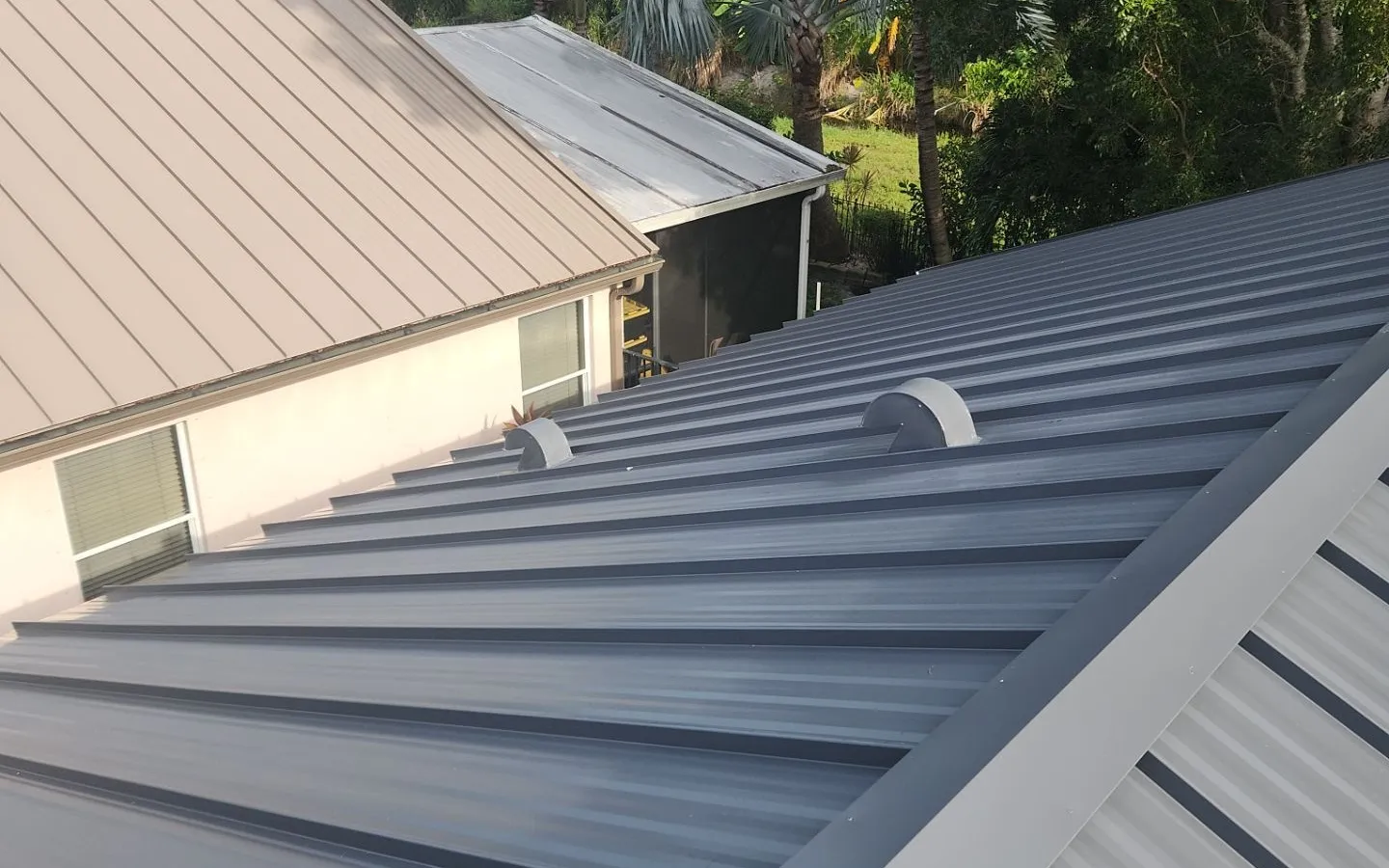
They are not, and the maintenance difference is real. A standing seam roof has its fasteners concealed under the seams, with clips that let the panels move. Far fewer penetrations, far less to go wrong. An exposed-fastener roof - the corrugated or ribbed panel screwed straight through - is cheaper and faster to install, and every one of those screws is a maintenance item for the life of the roof. Both are legitimate. They are not the same commitment.
Myth: it can't rust
Modern panels are coated, and the coating is good. But every cut edge, every scratch from a dropped tool, and every place a dissimilar metal touches it is a place the coating is not. Coastal air accelerates all of it. A scratch that shows a thread of rust is a cosmetic problem this year and a hole in ten.
Dissimilar metals deserve their own sentence: copper, and treated lumber, and certain fasteners, should not be in contact with a steel panel. Where a previous trade has left something touching the roof that should not be, it corrodes at the contact point.
What an annual look actually checks
- Fastener heads - backed out, missing, or with a washer that has visibly perished.
- Sealant at every end lap, ridge, hip and penetration - cracked, separated, or gone.
- Panel edges and any scratches - for the first sign of corrosion.
- Valleys and behind any curb or chimney - debris does the same damage it does on any roof.
- Anything touching the panels that should not be.
The honest summary
A metal roof is one of the best long-term decisions a Florida homeowner can make, and the maintenance is genuinely light compared to other systems. It is not zero. The parts that fail are small, cheap, numerous, and invisible from the ground - which is exactly the profile of problem that an annual visit exists for.
Repair work on metal roofs is scoped and estimated on its own; we are not going to guess at a fastener count from a paragraph.
Both plans include the surface and flashing review that finds perished washers and separated sealant while they are still a tube of sealant and a box of screws.
Compare the plans