
The field is the easy part
A low-slope roof - modified bitumen, TPO, built-up, or a coating over any of them - is a continuous membrane. In the open field that membrane is a large sheet doing exactly one job, and it mostly does it. Almost every leak on a flat roof comes from where the membrane has to stop, turn, go up or go around something.
The perimeter
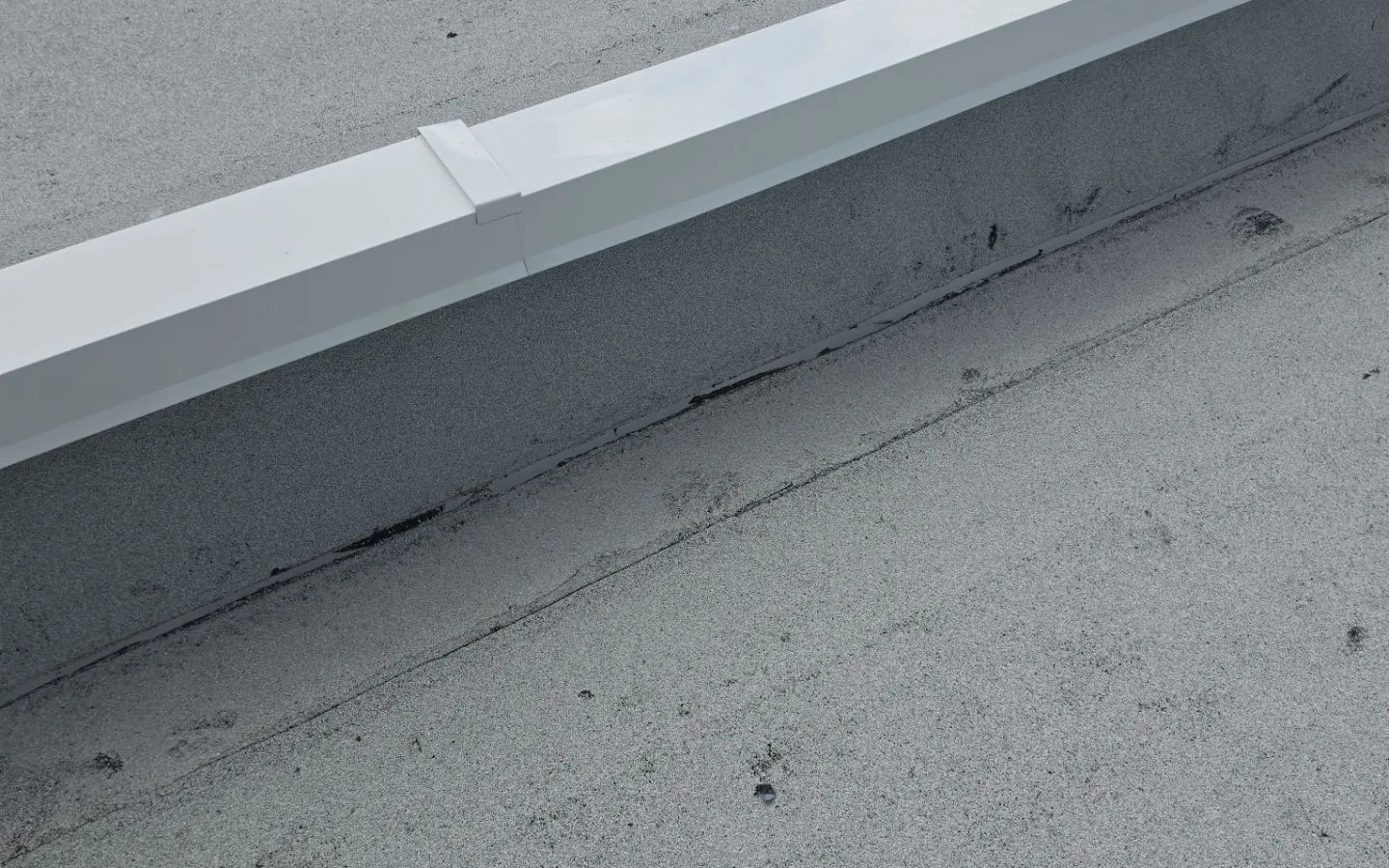
At the roof edge the membrane either turns down over a metal drip edge or turns up a parapet wall. Either way, there is a termination - a place where the membrane ends and something has to seal that end. Metal edging loosens, its fasteners back out, the stripping ply or sealant over it cracks. Parapet caps let water into the wall behind them. The perimeter is the longest detail on the roof and it is exposed to the most wind.
Penetrations
Every pipe, vent, curb, conduit and equipment stand is a hole in the membrane that somebody had to flash. Pipes get a boot or a pitch pocket; curbs get the membrane turned up and capped; conduits often get a tube of sealant and a hope. Each penetration is a small, individual detail, and a roof with rooftop equipment can have dozens. Look at each one: is the flashing sealed to the pipe at the top, and is it still bonded to the membrane at the base?
Walls
Where the flat roof runs into a higher wall, the membrane goes up the wall and terminates under a counterflashing or a reglet. Stucco applied straight over the termination, a counterflashing that has pulled away, or a termination bar with failed sealant - all of these let water behind the membrane at the top, where it then runs down between the membrane and the wall.
Drains and scuppers
Where the water leaves. A drain bowl with a failed seal at the membrane, a strainer full of debris, a scupper whose flashing has cracked - each one turns the exit into an entry. Because water concentrates there, a small fault at a drain leaks more than a large one in the field.
The habit
Walk the perimeter. Look at every penetration. Look at every wall termination. Look down every drain. Then look at the field. On a flat roof, that order is the right order, and it is the order a Roof Sentry visit follows.
Perimeter, penetrations, walls and drains - the flat-roof checklist, photographed every visit.
Compare the plans