
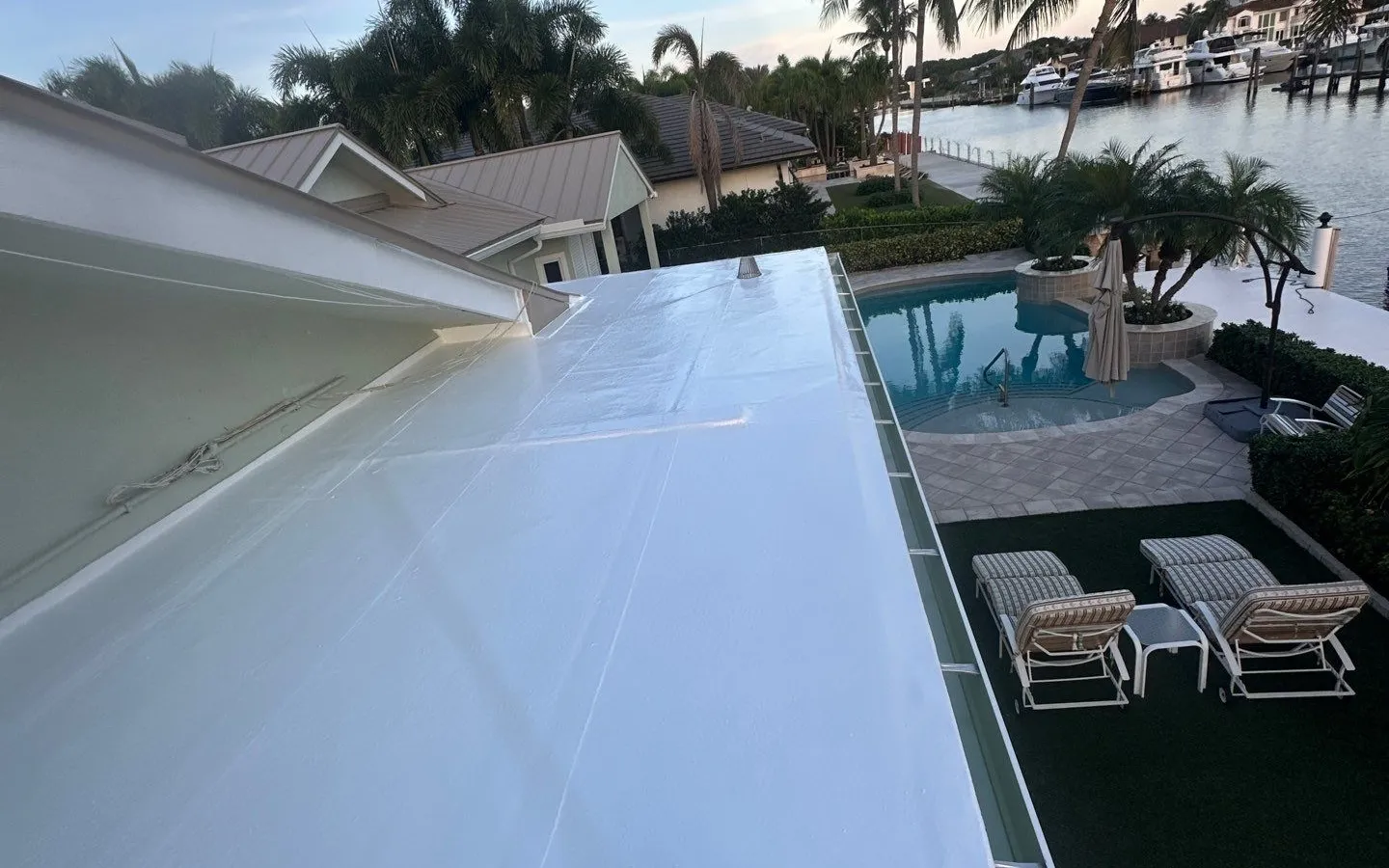
How the water leaves
A low-slope roof still slopes - a little - towards its drainage points. Those are either internal drains (a bowl set into the membrane, connected to a pipe that runs down through the building) or scuppers (an opening through the parapet wall or roof edge that lets water out to a downspout or simply off the edge). Many roofs have both, and most have an overflow - a second scupper set higher, so that if the primary blocks the water has somewhere to go before it reaches the top of the flashings.
How they fail
- Blockage. Leaves, fronds, seed pods, a tennis ball. A drain strainer exists to keep the pipe clear and it does that by collecting debris on itself - which means the strainer needs clearing or it becomes the blockage.
- The seal at the membrane. A drain bowl is clamped to the membrane with a ring. When that seal fails, water runs down the outside of the pipe, into the building, while the roof appears to be draining perfectly.
- Scupper flashing. A scupper is a hole through a wall with a metal or membrane liner. Where the liner meets the roof membrane and the wall, it has to be sealed on all sides. A cracked scupper liner leaks into the wall.
- Settlement. Buildings move. If the roof has settled so that the low point is no longer at the drain, water sits where there is no exit.
Why it matters more than it looks
Water on a flat roof sits against the flashings. Every inch it rises is an inch closer to the top of a wall termination or a penetration flashing. A blocked drain in a heavy rain can take a roof that was dry at two inches of depth to leaking at four. It is also weight: a roof holding a few inches of water over its whole area is carrying a load it may not have been designed for.
The one check
After a heavy rain, look at the roof. Is the water gone within a day or so? Is the water gone from the drain area in particular? Is there a ring of debris around the drain? Is the overflow scupper dry (good) or has it been running (the primary is blocked)? None of that requires a roofer. It requires looking.
What maintenance does
Clears the drains and scuppers, checks the strainers, checks the seals, photographs the ponding pattern so that settlement shows up as a change over time. It is not complicated. It is the part of flat-roof maintenance that most directly prevents the expensive outcome.
Drains, scuppers and overflows cleared and photographed on every visit - and the ponding pattern tracked year on year.
Compare the plans