
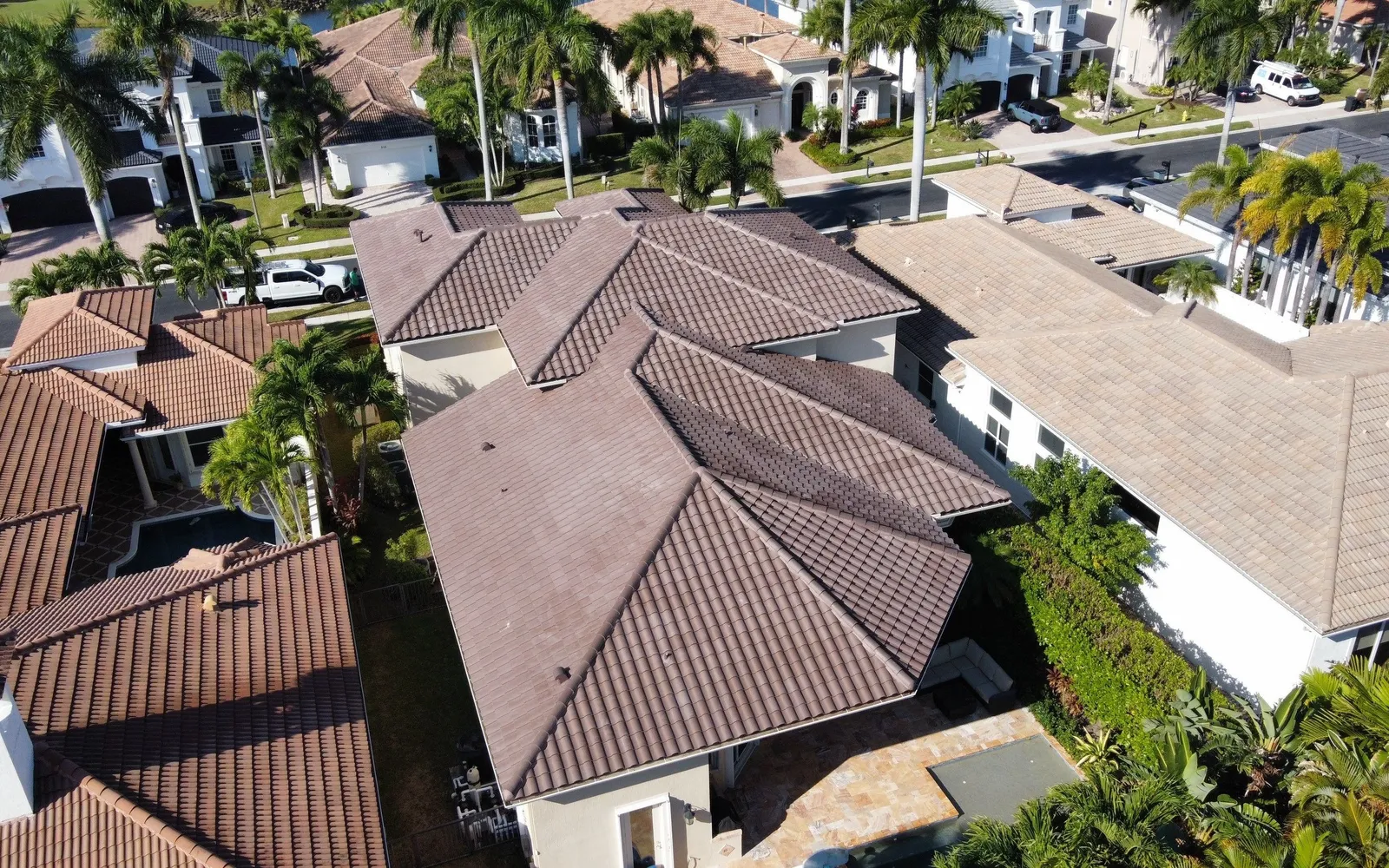
The field of a roof - the big open slopes - is the easy part. It was installed in long runs by people who were not thinking hard, because they did not need to. Where roofs fail is where the field meets something else, and in Palm Beach County the same five somethings come up again and again.
1. Pipe boots
Every plumbing vent through the roof has a rubber collar sealing it. Rubber and Florida sun are not friends. The collar splits on its upper edge, water runs down the pipe into the attic, and the stain shows up on a ceiling nowhere near the roof edge. It is the single most common leak we find, across every roof type, and it is a ten-minute repair when caught.
2. Valleys and crickets
Where two slopes meet, water volume doubles and debris collects. A valley full of leaves holds water against the membrane through every rain, and a cricket behind a chimney does the same job of damming things up. Clearing them is not glamorous. It is most of what "maintenance" means.
3. Roof-to-wall transitions
Wherever the roof meets a vertical wall - a second storey, a chimney, a parapet - there is flashing, and above the flashing there is stucco. Cracked stucco lets water behind the flashing; failed sealant at the top of the flashing does the same. This junction is where a large share of "the roof is leaking" calls turn out to originate, and the roof itself is often fine.
4. Whatever someone else attached
Satellite dishes, solar mounts, holiday-light clips, security cameras, the new gooseneck the air-conditioning company cut in. Every one is a hole in the roof made by someone who is not a roofer, sealed with whatever was in the truck. Years later, the sealant is gone and the hole is not.
5. The ridge and hip line
On tile, the mortar or foam along the top edges cracks and lets tiles loosen. On shingle, the ridge cap takes the most sun and the most wind and it curls first. On metal, the ridge closure is a sealant joint. The highest line on the roof is the one that sees the most weather.
The pattern
None of these five is visible from the driveway. All of them are cheap when found in the same year they start, and expensive when found by a ceiling stain two seasons later. That gap - between the year it starts and the year it shows - is the entire reason for an annual look.
A Roof Sentry visit checks all five, photographs them, and puts each one on your roof map with a note on its condition.
Compare the plans